
 Български

 Cyberthread Defence
 Data Protection & Backup
 Identity and Access Protection
 Strengthen Security Posture
 Physical Security IT Solutions
 Implementation, management and development
 On-premise
 Hybrid
 Cloud
Cloud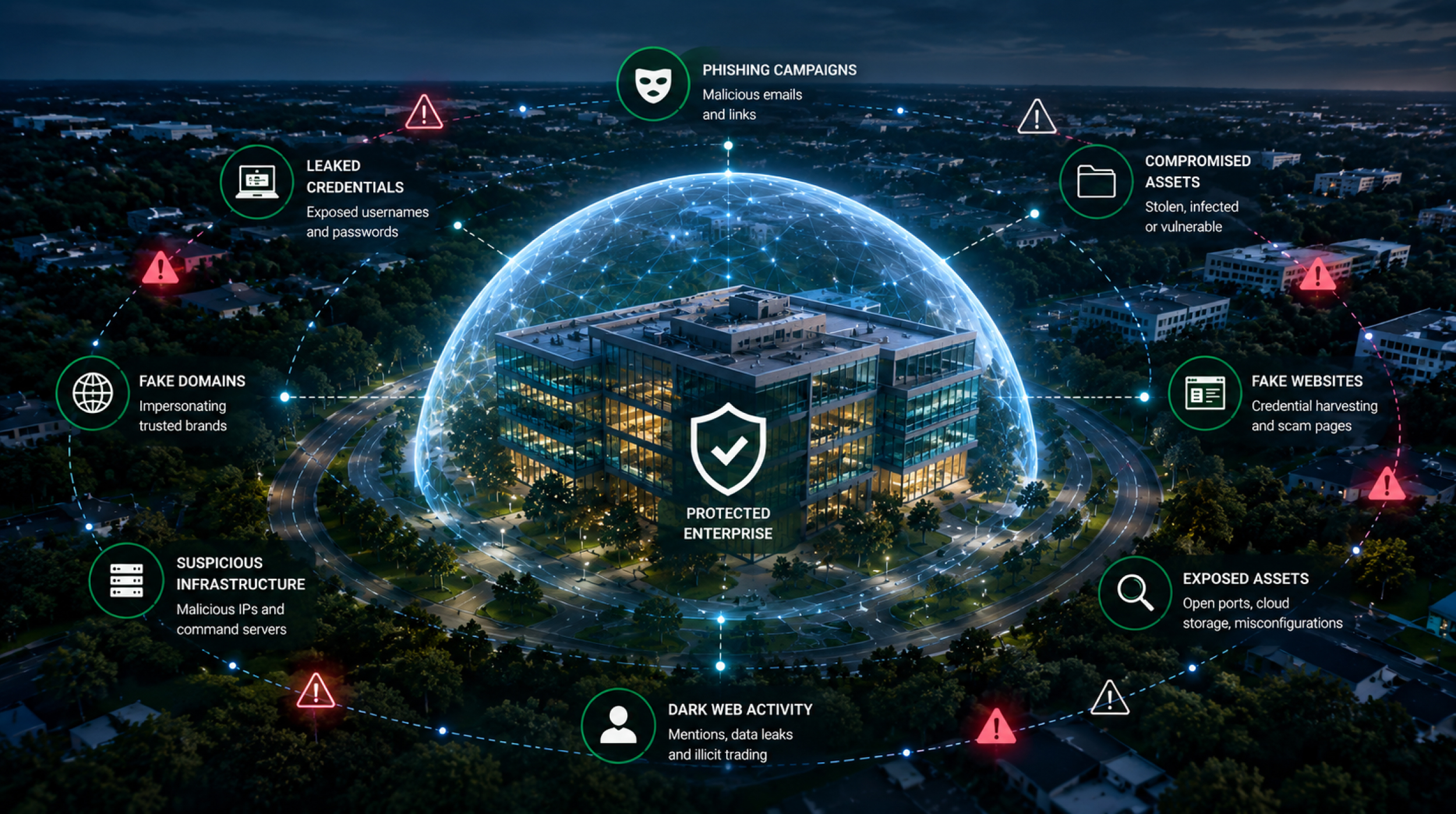
← Back to Threat Intelligence
How Threat Intelligence Works
Most cyberattacks do not begin with an alert inside the organization’s infrastructure.
They start much earlier—with leaked accounts, fake domains, phishing campaigns, compromised assets, or activity across the deep and dark web.
Threat Intelligence combines technology, analysis, and expert assessment to transform external risk signals into actionable insights.
Without external visibility, early warning signs remain invisible—even to experienced security professionals.
By the time an attack reaches internal systems, it is often already underway. That is why Threat Intelligence shifts defense earlier—into the attack preparation phase itself.
The Threat Intelligence Process
To transform external risk signals into real protection, the process goes through several sequential stages.
1. Detection
Continuous monitoring of:- public sources (OSINT);
- the deep and dark web;
- exposed assets and external attack surface;
- domains, IP addresses, and digital assets;
- phishing activity and brand abuse.
2. Analysis and Context
The collected information is analyzed and enriched with context:- its relevance to the specific organization;
- its potential business impact;
- affected assets, people, or services.
3. Prioritization
Not every threat requires immediate action. Threat Intelligence evaluates:
- the likelihood of a real attack;
- the potential business risk;
- the criticality of affected assets;
- the possible impact on operations, reputation, and trust.
This enables security teams to focus on the risks that truly matter.
4. Action
When a real risk is identified, Threat Intelligence supports:- early response;
- investigation and analysis;
- reduction of exposure;
- recommendations for technical and organizational measures;
- enhancement of security controls.

Threat Intelligence as Part of SOC
When integrated with LIREX SOC services, Threat Intelligence strengthens day-to-day cybersecurity operations through greater context, faster response, and better prioritization.
- 24/7 monitoring;
- alert enrichment with contextual intelligence;
- faster incident investigation;
- prioritization based on business risk;
- more effective response.
As a result, Threat Intelligence becomes an operational component of everyday cyber defense rather than just a static report.
From External Signals to Actionable Intelligence
Threat Intelligence helps organizations identify risks earlier, understand them more clearly, and respond before they become real security incidents.
Contact a LIREX expert for a personalized solution.
📧 office@lirex.com
📱 +359 2 9 691 691