
 Български

 Cyberthread Defence
 Data Protection & Backup
 Identity and Access Protection
 Strengthen Security Posture
 Physical Security IT Solutions
 Implementation, management and development
 On-premise
 Hybrid
 Cloud
CloudThreat Intelligence
See threats before they become incidents
Early visibility into real cyber risks, phishing campaigns, compromised assets, and external digital threats.
How Threat Intelligence Works →
Cyberattacks do not start within your infrastructure.
They begin much earlier, in environments beyond the visibility of traditional security systems.Threat Intelligence transforms external risk signals into timely action, better decisions, and more predictable cybersecurity.
Early visibility into real cyber risks, phishing campaigns, compromised assets, and external digital threats.
How Threat Intelligence Works →
Business Benefits of Threat Intelligence

1. Earlier Threat Detection
We identify risks at their earliest indicators — before the actual attack begins.
2. Less Operational Noise
We filter out irrelevant signals and focus on threats that have real business impact.
3. Faster and More Effective Response
We identify which threats require immediate action and accelerate response to real risks and incidents.
4. Brand and Reputation Protection
We detect and mitigate early attempts of brand abuse, fake domains, and phishing campaigns.

5. Reduced Business Risk
We reduce the likelihood of financial loss, operational disruption, and reputational damage.
6. A More Effective SOC
For organizations with their own SOC, we enhance visibility and improve SOC efficiency through more accurate intelligence and faster response times.
Most Organizations Detect Attacks Too Late
Before an actual breach occurs, external warning signs often already exist:
- Leaked credentials
- Fake domains
- Phishing campaigns
- Compromised assets
These indicators frequently appear days or even weeks before the attack itself. Without external visibility, organizations often react only after the incident is already underway.
Threat Intelligence shifts security earlier — into the attack preparation phase.
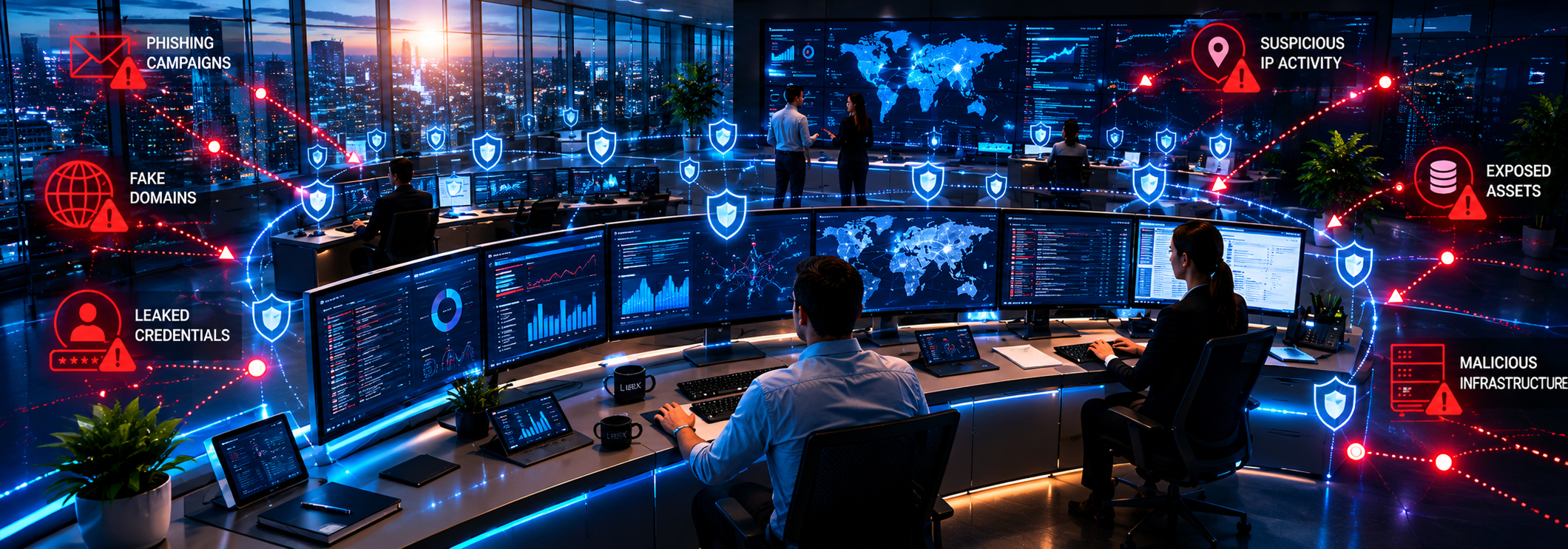
As Part of SOC or as a Standalone Service
Threat Intelligence and SOC
Integrated with LIREX SOC services, Threat Intelligence supports:- 24/7 monitoring and analysis
- Alert enrichment with contextual intelligence
- Faster incident investigation
- Business risk-based prioritization
- More effective response
Standalone Service
Threat Intelligence can also be deployed as a standalone service for organizations seeking external visibility into:- Credential leaks
- Phishing activity
- Brand abuse
- Attack surface exposure
- External digital risks
Core Areas of Threat Intelligence for External Cyber Visibility and Protection
Digital Risk Protection
Visibility into external digital risks affecting the organization — including data leaks, compromised accounts, and emerging attack activity.Dark Web Monitoring
Early detection of leaked data, compromised accounts, phishing campaigns, and threat activity related to the organization.
Brand Protection
Protection against misuse of brand name, domains, logos, and digital identity.Personal Protection
Protection of executives and key employees against targeted attacks and identity theft.Attack Surface Management
Identification of exposed assets, external exposure, misconfigurations, and potential vulnerabilities.Threat Intelligence Is Valuable For Organizations that:
- Depend on digital channels
- Process sensitive data
- Manage brand reputation and trust
- Have high external exposure
- Operate in complex or distributed IT environments
Suitable for:
- Enterprise organizations
- Financial services
- Healthcare
- Retail and eCommerce
- Manufacturing
- Public sector
- Organizations operating critical services and infrastructure

Why LIREX
LIREX delivers an integrated approach to managed cybersecurity — from monitoring and analysis to response and risk mitigation.
We combine:- Expert SOC teams
- 24/7 monitoring
- Early threat detection technologies
- Context-driven analysis
- A business-oriented approach to cyber risk
Threat Intelligence is not just a tool or a report. It is a continuous process that supports better decisions and more predictable security outcomes.
Frequently Asked Questions
What is Threat Intelligence?
Threat Intelligence is the process of collecting, analyzing, and interpreting information about cyber threats from public, restricted, and dark web sources to enable early risk detection and mitigation.
How is it different from standard monitoring?
Traditional monitoring solutions primarily focus on internal infrastructure. Threat Intelligence provides visibility into threats outside the organization — where attacks often begin.
What sources are monitored?
Threat Intelligence uses public sources (OSINT), deep and dark web monitoring, technical indicators, phishing activity, exposed assets, and global intelligence feeds.
Is it suitable without a SOC?
Yes. Threat Intelligence can be deployed either as a standalone service or as part of an integrated SOC offering.
How is “noise” reduced?
Through contextual analysis, correlation, and business risk-based prioritization, allowing organizations to focus only on threats that truly matter.
Can the value be measured?
Yes. Organizations can track earlier threat detection, incident reduction, and minimized business impact over time.
Contact a LIREX expert for a personalized solution.
📧 office@lirex.com
📱 +359 2 9 691 691
Submit an Inquiry