
 Български

 Cyberthread Defence
 Data Protection & Backup
 Identity and Access Protection
 Strengthen Security Posture
 Physical Security IT Solutions
 Implementation, management and development
 On-premise
 Hybrid
 Cloud
Cloud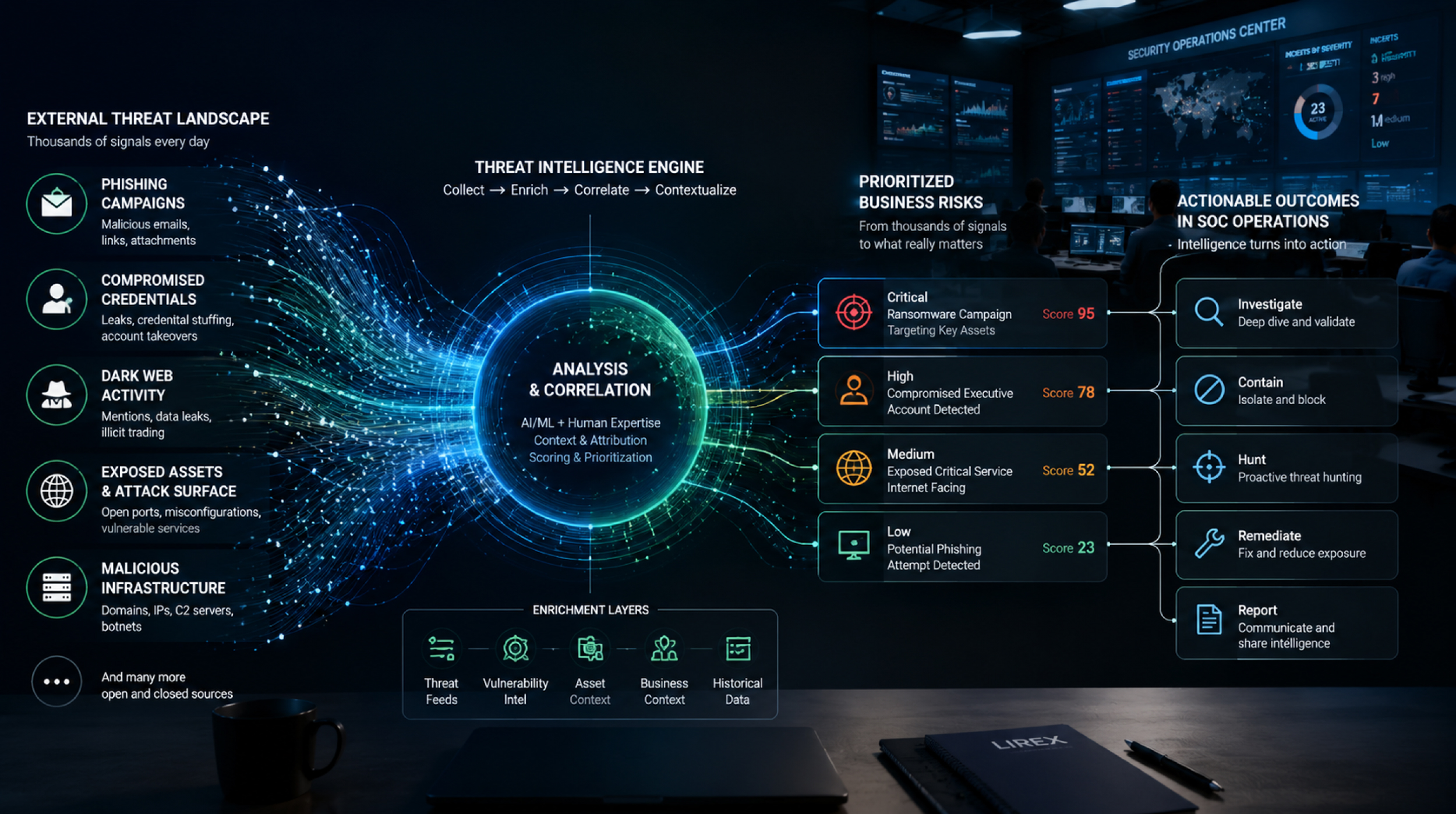
← Back to Threat Intelligence
How Threat Intelligence Works as Part of SOC
Within the LIREX SOC, Threat Intelligence is an integrated process in which external cyber threat information is not treated separately but is directly incorporated into the daily operations of the security team.
The goal is to reduce the time required to detect, understand, and respond to threats by adding context to every event and focusing attention on the actual business risk.
Threat Intelligence transforms external signals into operational context for the SOC team.
This process covers the entire lifecycle of a threat—from the first indicator through investigation and real-time response.
Stages of Integration Between Threat Intelligence and SOC
1. Continuous Intelligence Collection
SOC and Threat Intelligence operate on a continuous stream of data collected from multiple sources:
- public sources (OSINT);
- deep and dark web environments;
- technical indicators of compromise (IOCs);
- monitoring of domains, IP addresses, and digital assets;
- phishing campaign and brand abuse intelligence;
- external attack surface monitoring (eASM).
Information is collected continuously rather than periodically, enabling the early detection of potential threats.
2. Enrichment and Contextualization
Raw data has little value without context. In the SOC environment, every piece of information is analyzed in relation to the specific organization:- whether it affects real assets;
- whether it is linked to technologies or services in use;
- whether it matches known attack tactics and patterns;
- whether there is historical similarity with global campaigns.
3. Alert Enrichment
When SOC systems detect an event, Threat Intelligence adds an additional layer of context:- whether the IP address is associated with malicious activity;
- whether the domain is part of a phishing infrastructure;
- whether a user account has been compromised;
- whether the activity is linked to a known threat actor, attack, or campaign.
4. Prioritization Based on Business Risk
Not all incidents carry the same level of risk. Supported by Threat Intelligence, the SOC classifies events based on:- the likelihood of a real attack;
- the potential business impact;
- the criticality of affected systems and data;
- reputational risk.
5. Incident Investigation and Analysis
During an active incident, Threat Intelligence supports the SOC team with:- historical context on threat actors and attacker groups;
- related indicators of compromise (IOCs);
- known tactics, techniques, and procedures (TTPs);
- intelligence from previous campaigns and incidents.
6. Response and Risk Mitigation
In the final stage, Threat Intelligence supports the SOC team with:- blocking malicious sources;
- containing compromised accounts;
- closing vulnerabilities and external exposures;
- providing recommendations for technical and organizational measures.
What Does the Integration of Threat Intelligence into SOC Achieve?
- earlier threat detection;
- fewer false positives;
- faster incident investigation;
- greater operational efficiency for security teams;
- lower overall business risk.